
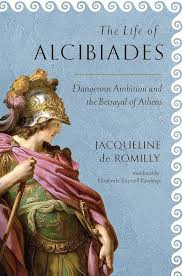
Jacqueline de Romilly, The Life of Alcibiades: Dangerous Ambition and the Betrayal of Athens (1995).
Good Reads meta-data is 228 pages, rated 4.18 by 139 litizens.
Genre: Biography.
DNA: Greece.
Verdict: Superb.
Tagline: Mad, bad, and dangerous to know.
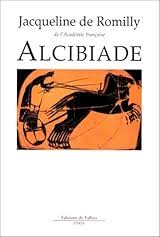
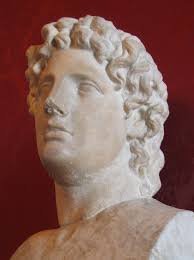
If a single person dominates Thucydides’ History of the Peloponnesian War it is Alcibiades (450 BCE- 404 BCE). Larger than life, he is a protean figure, a shapeshifter, born an Athenian, become a Spartan, then a Persian, again an Athenian, and finally nothing but himself. Each metamorphosis he made, he betrayed. Even knowing that, the next host welcomed him, and soon enough he betrayed that one, too. His motto must have been ‘All for me, and me for me, too. End.’ (Thanks to Michael Neylan for that phrasing.)
In fact, I grew weary and confused in following de Romilly’s map of his duplicitous and constant self-serving. The twists and turns come fast and furious: U-turns, hairpins, swerves, one-eighties, esses, reversals with spin, and more.
Teacher’s pet of Socrates and adopted son of Pericles, born an aristocrat with gifts of the gods in wealth, health, appearance, physique, and so on, he was also vain, arrogant, tempestuous, conniving, egoistical, solipsistic, and….a completely spoiled only child.
With a tongue of electrum, time after time he talked his way out of his own lies. At one point he demanded Athens change its regime to suit him, and that is what happened but by then he had grown bored and had himself changed sides again. At times he was a fervent exponent of Athenian democracy and at other times an equally fervent exponent of Athenian oligarchy. And on one occasion he was both at once.
I struggled for a sporting metaphor to describe him. He changed team uniforms with record speed, but also positions of the field and sports at will. He was so versatile he could play both for an against himself to the cheers of the crowd.
(No good? Do better.)
Were he a fictional character, he would be unbelievable. Fiction has to be credible, but reality does not and that maxim applies to Alcibiades. De Romilly, too, is at times at a loss to understand why he got away with it time after time. All she can do is repeat that he did. See also David Stuttard, Nemesis: Alcibiades and the Fall of Athens (2018).
The obvious comparison is Achilles in the Iliad whose astonishing attributes have a divine explanation.
* * *
On our visit to Athen in the Agora Museum I saw a shield with his name Ἀλκιβιάδης scratched into the forearm brace. Later at a virtual museum (the name of which I have forgotten but which must be recorded in the travel diary on the shelf) we saw an interactive video about ostracism and I cast my vote for Al to go. In the Kerameikos I saw the tombstone for his first wife, Hipparete. His is a long shadow.
He is a major character in Shakespeare’s Timon of Athens, and in many novels, particularly Mary Renault’s The Last of the Wine (1956). Al has entered fantasy in Paul Levinson’s Sierra Waters time travelling series. There Alcibiades found someone else to believe his endless stream of lies.
Strangely, his name on the IMDb yields scant returns. He could give Hollywood lessons. Per Michael Netyan.
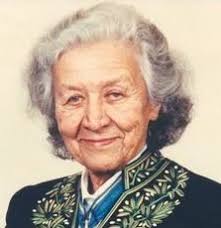
P.S. Madame de Romilly née David was 82 when she published this book in French. For the agrégation in 1936 she had learned Greek. Thereafter she stayed in the Greek world with a Sorbonne PhD on Thucydides, part of which was written while hiding in Aix-en-Provenance from the Vichy police rafle searching for Jews to murder.
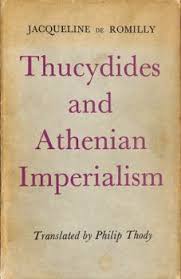
The dissertation was reworked and became her magna opus as Thucydides and Athenian Imperialism (1947). It is one of her more than thirty titles on ancient and classical Greece. I saw her give a public lecture in 1980 in a campaign to stimulate popular interest in the past. A place near the Sorbonne now bears her name.