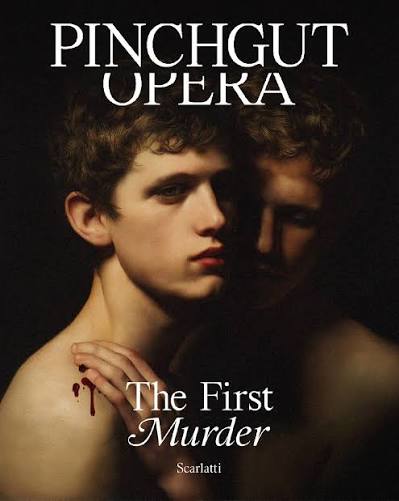
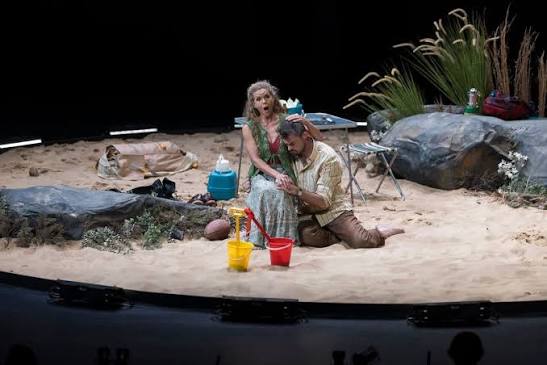
In May (that indicates what my backlog is like) we went to the Roslyn Packer Theatre for a performance by the Pinchgut Opera company of this baroque oratorio about the brothers Cain and Abel.
I had high hopes for Scarlatti’s music. Fratricide, murder, damnation, expulsion, guilt, punishment, and exile seemed dramatic and dynamic subjects for some stirring music. Instead I watched some depressed and morose people mill around a sandpit like it was an unwelcome day out with the in-laws in sunny Strineland.
The critics praised it, I read later after seeing for myself, but I fear I am not on that wavelength and found it barely held my attention. I noticed more than one other in our seating area nodding off (though no names will be mentioned) as the glum proceedings crept on, and in the second half there were many empty seats in front of us, as others had decided to cut their losses and leave long before the curtin. Do reviewers take note of the audience reaction?
N.B. for future visits to the Roslyn Packer Theatre, try for seats H 32 & 33, J 32 & 33, K 33 & 34m, and then enter via the wheelchair entrance to the left of the men’s toilet on the street level. Best for leg room for me and my inflexible knee.
Good meta-data is 208 pages, rated 4.03 by 474 litizens.
Verdict: Predictable.
Tagline: The probe did nothing and that was enough!
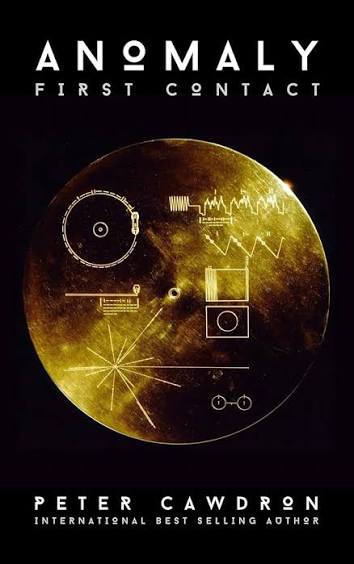
Another title in the series of studies of human reaction to the reality of an alien, in this case an inert object plonked down in front of the United Nations building on East 42nd Street in New York City. In the main the story concerns the human reaction to the irrefutable realisation that this is an alien object.
Irrefutable or not, Fox News talking heads deny its reality until it can no longer be denied then blame in on the Obama Biden Triangle. Sock Puppets never change.
It all began as an elementary school science teacher, whose turn it was to escort a tour, took a small group of students to see a United Nations session when the anomaly appeared before their very eyes. The story is told from his perspective as he gets caught up in the reactions.
The responses are many, and largely predictable, though entirely credible.
First is the public irritation at such a major disruption to the ebb and flow of the city at mid-morning on a working day. Much horn honking, cursing, and the like. Only gradually does the realisation bloom that this is no normal SNAFU of a broken down bus, a geysering fire hydrant, or chain fender bender. No! This FU is an Abnormal Situation: ASAFU.
Second, the police cordon off the immediate area and re-route traffic. Contingency plans for demonstrations in front of the UN are applied.
Three, gawkers arrive en masse with selfie sticks and the police are stretched to keep them away from the site. (N.B. Since the advent of selfies eight people at least have fallen backward into the Grand Canyon, according to the Park Service, trying to get a selfie. None survived but they, their sticks, and phone cameras were eventually recovered, perhaps preserving a record. Others have backed into volcanos or boiling mud. Natural de-selection.)
Four, officialdom descends from Washington D.C. in the person of the director of the National Security Agency. (The FBI director was tanked.) He arrives with a platoon of Marines and a gaggle of scientists. The scientists are giddy with excitement trying to analyse the whatever it is. The Marines stand around looking like Marines in desert camos.
Five, the entrepreneurs appear first to sell coffee and donuts to the gawkers, police, officials, scientists, newshounds, and Marines. They later offer T-Shirts and hats as souvenirs.
Six, the representatives of several member states of the United Nations declare their possession of the thingamabob (because it might be valuable) and they saw it first. They take the matter to the World Court which with much bluster convenes with empty solemnity. Likewise the United Nations Secretariat claims sovereignty over the whatsit. The USA refuses these bids but is pressured into transparency in its investigation of the thing. To be transparent just means taking extra precautions for secrecy, or so the NSA director thinks.
Seven, the god squad goes bonkers in the company of the National Inquirer readership of conspiracy theorists, UFOlogists, and neural divergent Fox News-oholics. The god squad blames science while denying the object is alien. Yet the object is certainly not of this world as is made abundantly clear in the text in ways that would be spoilers to repeat here, but which might penetrate a brick brain though not the present President.
Eight, for many this advent heralds the end of the world with attendant riots and such. Once the chaotic reaction in New York City is broadcast by Fox News to the world at large in the most sensational way possible, the disorder spreads to other places – Paris, Rome, Beijing – far from the anomaly; they all go up in flames. Of course, Fox News blames the Obama-Biden cabal for this disturbance and its talking heads all agree with noddies. These latter sock puppets demand that Hillary Clinton testify for hours about her use of the semi-colon.
Nine, the National Security Agency Director decides it is a threat, though it is inert, and calls for more Marines. And more. The coffee sales go up.
Ten, around the world humans continue destroying things and each other. Meanwhile the whateveritis sits inert. It is a mirror in which we see ourselves as we truly are confused, ignorant, myopic, hostile, selfish, paranoid, aggressive, divided, impatient, destructive, and stupid. (Reminded me of that big shiny silver bean in Chicago.) Meanwhile, the alien object remains silent and still. It doesn’t take much to bring out the worst in us, right Brother Hobbes?
The science teacher is an everyman (and there is an everywoman, too) who is a participant-observer on all of this. For readers he translates the heavy duty science into comprehensible doses.
Peter Cawdron
I took liberties above to avoid spoilers but get the idea across.
As usual with Peter Cawdron, the research into locale is meticulous, the characters are diverse, different, and well drawn. The prose gets the job done. Chapeaux!
Good Reads meta-data is 260 pages, rated 3.66 by 306 litizens.
Genre: krimi.
DNA: England.
Verdict: More.
Tagline: [See title above]
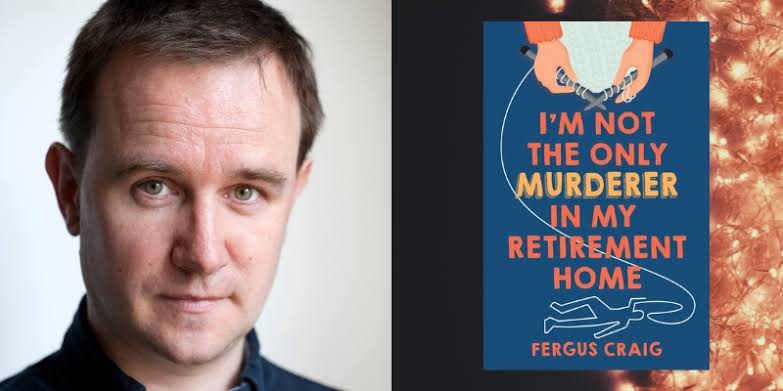
When an elderly denizen of the ever so posh Sheldon Oaks residence (for retirees) in Hampstead near the heath is murdered, all eyes turn to the convicted killer who lives there and who had served her time – decades – and who used some ill-gotten gains to buy into the Oaks. No brainer, innit?
But for once she didn’t do it, and sets out to clear her name, impeded by blundering plod who is indeed a no-brainer. The plot thickens. In time she enlists other superannuated codgers over 70, a pathologist, a Met detective, and a minister of the crown – each well past the use-by date – to piece it together and figure it out. They push Zimmer frames, wear hearing aids, tire walking ten feet, and take frequent naps, but they get there in the end.
The proceedings are droll, and sometimes not so very cozy, and the plot in layered. In short, nicely done.
Good Reads meta-data is 224 pages rated 3.40 by 104 litizens.
Genre: krimi.
DNA: Kenya.
Verdict: Atmospheric.
Tagline: Ouch!
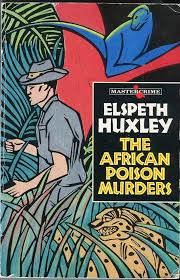
Colonial Kenya in the late 1930s is the setting. Our investigator is a Canadian who wanted to see the world and entered the Empire’s colonial service. He is sent from the capital to a farming community to monitor some local Germans.
These Germans were the descendants of the colonists of German East Africa which passed to the English in 1919. When Germany’s African colonies changed hands, some of the colonial Germans preferred to move to Boer areas in South Africa. Others went to Kenya. Wherever they live, they were hostile to the British, and so London keeps an eye on them, and that eye in this story is the Canadian.
Members of this German diaspora stick together in tight communities, and these are being courted, infiltrated, or manipulated by Nazis. Remember the time is slightly pre-war. The activities are legal, but….
Then even as investigator imbibes a G and T, the local German leader dies. Then other things happen, and the plot gets thick. Very. The farming community is surrounded by jungle, and that adds to the brew. There are many natives about but they play no role in the white mischief.
***
Huxley wrote two more krimis, and I will pursue them. I got this one on EBay and it is a large print edition culled from the Library of South Australia. I found it hard to read, because I am not used to such large print which made it harder for me. Strange but true. The large print adds a third to the book’s length
Elspeth Huxley
The author was born and raised in Kenya and published many other books, some autobiographical. And also one about the coming of the Europeans to Africa from a native perspective. I might read that one, too.
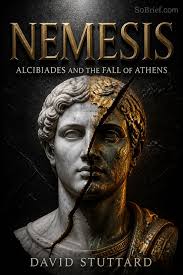
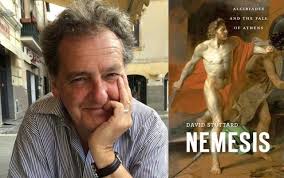
David Stuttard, Nemesis: Alcibiades and the Fall of Athens (2018).
Good Reads meta-data is 380 pages, rated 4.29 by 169 litizens.
Genre: Biography.
DNA: Greek.
Verdict: Amazing.
Tagline: The bigger the lie, the more often it is repeated.
Alcibiades is the most singular figure of the 500+ individuals named in Thucydides’s History of the Peloponnesian War. Alcibiades was larger than life; he was also a changeling. He could be all things to all people writ large. That makes him altogether a fascinating subject. Though like all the other writers drawn to this flame, the author cannot penetrate the mystique, but not for the want of trying.
Alcibiades traced his lineage back to the mythical Ajax, but there is no doubt Alcibiades was of mortal woman and mortal man born. His singular qualities were human, not divine. When his wealthy father died, he was adopted by Pericles, and later became a teacher’s pet of Socrates. Both the politician and the philosopher found him attractive, impulsive, smart, stubborn, brave, daring, mercurial, and erratic even as a boy, and he remained so as a man.
In the boy we can see the man coming; and in the later man we can see the boy he remained. But not completely. That shape-shifting ability to convert himself instantly into being more Spartan than any Spartan; to become in a flash more Persian than the Great King himself; to live a rustic with ease, these remain behind the curtain. By what alchemy was he able to use protean magic immediately and completely remains a mystery. I also wondered about languages but got no enlightenment.
Despairing of the boy, Pericles sent him to his brother to rear, who in turn gave up and let this privileged and spoiled brat run wild. Socrates tried to turn Alcibiades to philosophy, and failed. (There are two Platonic dialogues named for Alcibiades in which Socrates has some success with the eponymous man, but these are later fictions. He is also a character in at least one other Platonic dialogue.) It is unlikely, on dates, that Plato ever met Alcibiades, though another older Socratic student certainly did, namely Xenophon, himself a soldier of distinction.
This author suggests that Thucydides interviewed Alcibiades for details that he included in his History of the Peloponnesian War when both were exiles from Athens in the north east of Greece. That is intriguing possibility partly because Thucydides is critical of, even hostile to, Alcibiades in his book.
***
The author offers a continuous narrative by piecing together shards from many sources, like those Platonic dialogues, other Greek fragments, and later Roman works of both fact and fiction, as well as Thucydides. It is an impressive quilt made from every mention of the man in the available, mainly fragmentary record, and sewing together the patches into this detailed, nearly month-by-month account, is a remarkable achievement.
Those Roman sources came many hundreds of years later, but the supposition is that they were based on still earlier and more proximate sources, now lost to posterity, rather than simply made-up. It is plausible, but….there would have been a market for fiction, too. Lies do sell. Demand creates supply.
I assumed, correct me if I am wrong, that these ancient sources have all been scanned and transcribed, and much searching for Alcibiades now can be done at a computer screen. Prior to that, delving into so many original sources, held all over the European world, would have been the labour of the lifetime, or more!
GoodReads meta-data is 270 pages rated 3.81 by 73 litizens.
GoodReads meta-data is 270 pages rated 3.81 by 73 litizens.
Genre: krimi.
DNA: Italy via Newark.
Verdict: Travelogue.
Tagline: Archaeology 101.
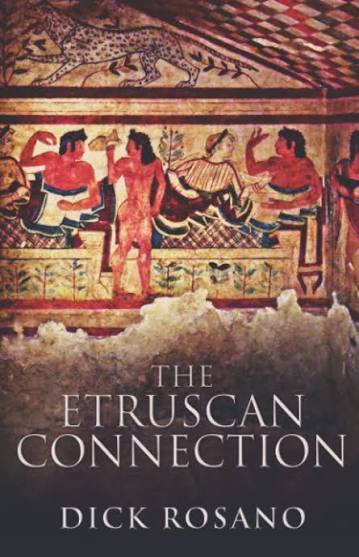
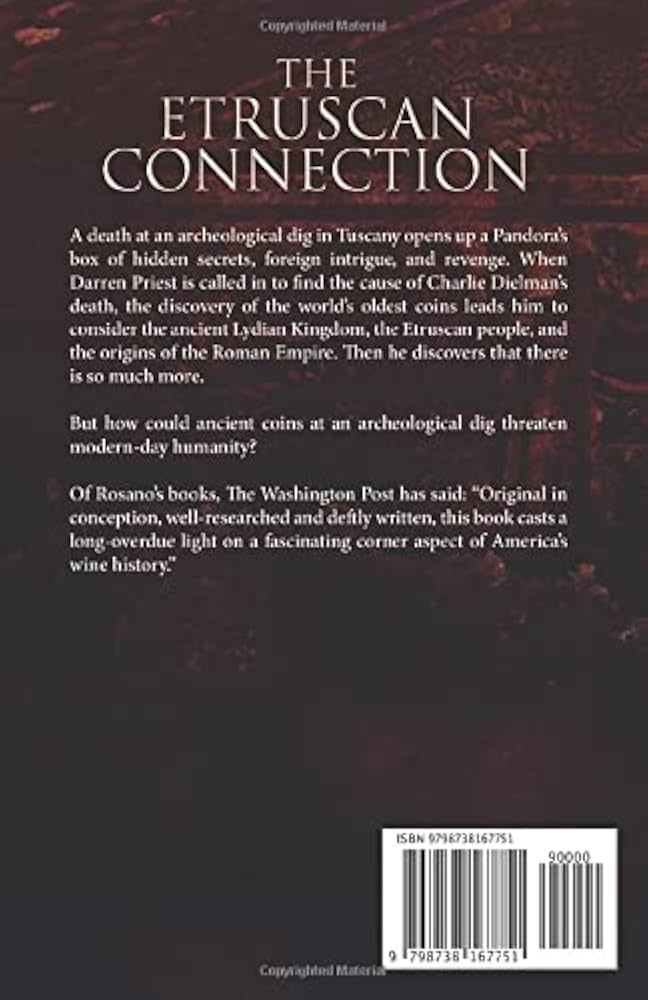
At about the 40% mark on the Kindle I gave up. It is continuous description of menus, hotel rooms, clothes, etc.
As for the Etruscan dig what we get is Archeology 101 definitions, not any texture of the work. There are pages and pages of exposition like that which follows.
‘I found it in a midden.’
‘What’s a midden?’
‘A midden is….’
‘Why were you looking in it?’
‘I am a physical archeologist.’
‘What is a physical archeologist?’
‘One who studies objects.’
‘What objects?’
‘Anything and everything we can find.’
‘Why?’
‘To learn out how people lived.’
‘Why?’
‘To understand the past.’
‘Why?’
…. and so it goes.
Such dialogue occupies page after page, but does nothing to set a scene at the dig. Nor does it develop character or advance the plot.
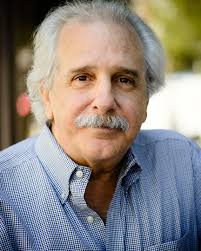
Dick Rosano
We know there is a big hole with scaffolding but none of this is made relevant. Nor is it fully described despite all the pedantry. Rather the emphasis is on the pointless dialogue. I say pointless because there is so much of it, very little of it is relevant to the plot, if there is one.
We have investigators from three countries who spend more time explaining to each other their terminology as above. We also get backstories about how they met previously, descriptions of their clothes, and menu deliberations. Much of the latter.
Even more distracting are the flashbacks from the ancient past about the origins of the Etruscans on the Anatolian upland. I skipped these.
Needless to say, some Good Readers found this book gripping. It takes all kinds, evidently, but I don’t know why. It is part of series for such readers. Dick has other connections, Paris and Vienna, and more besides.
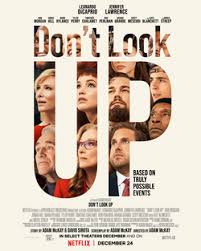
IMDb meta-data is a runtime of 2h and 18m, rated 7.1 by 672,000 cinematizens.
Genre: Dramedy.
DNA: Hollywood.
Verdict: Reality.
Tagline: A comedy about the end of the world.
The snobbery begins with the IMDb summary that reads ‘Two low level astronomers….’ discover the planet-killing asteroid is on course for the apocalypse. The unmistakable implication is that had they been higher level, i.e., from Cal Tech or Harvard rather than Michigan State, things might have been different.
What follows is a two lane satire, the first about the US media and the second about public opinion. Everything becomes a matter of opinion, and facts have no weight in this domain.
There are no votes (or graft) in death, accordingly no one in Washington wants to hear the news of the low-level astronomers. Desperate, they go to the media, where the cannibals descend on them for a repast. Both the sensation hungry media and the public it has trained to salivate are more interested in the coupling of the couple de jour than the coming disaster.
The Impact Deniers gain sway. Who wants that much bad news anyway? Although a business man sees profit in catastrophe and sets out to harvest it.
It is all a metaphor for climate change of course, but the hand is so heavy it becomes boring and predicable. Cutting 45m (all of the Musk clone) would have sharpened the stick. The star power of the mismatched leads cannot save it from the mute button. But I would welcome a President Streep especially since she forgets her own son in a crisis.
The last comedy about the end of the world I saw was Moon Man (2022) from China. It is discussed elsewhere on the blog. Click on for a comparison. i know which was more fun to watch, and less predictable.
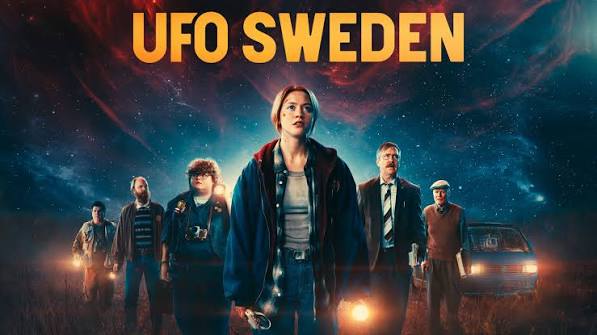
IMDb meta-data is runtime of 1h and 54m rated 6.4 by 8,400 cinemtizens.
Genre: Sci Fi.
DNA: Sweden.
Verdict: Diverting.
Tagline: The worm (hole) turned.
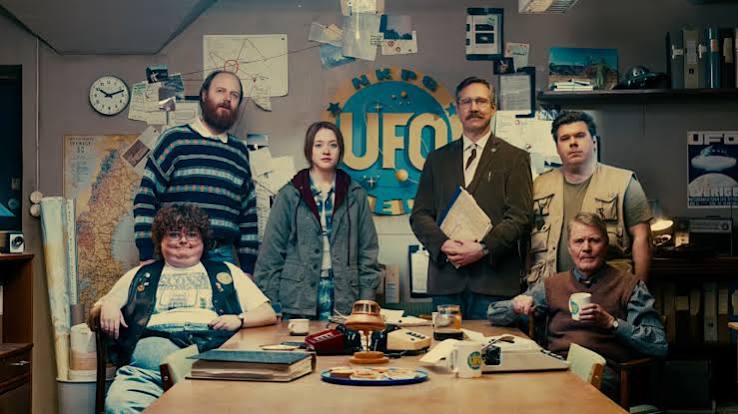
After her father disappears in the north woods one night UFO chasing, a young girl becomes obsessed with finding him. (There is neither wife nor mother in evidence.) In so doing she teams up with a group of misfit UFOlogists.
Her determination to do something — anything! everything! right now! — to find dad brings tensions to the group which has functioned more as a sheltered workshop for its members than an investigative project. Apple carts go flying. The weather and the bureau of meteorology figure in the story.
It all hinges on the adolescent lead who carries the picture. She is not in every scene but when she is there is an energy and urgency.
There are many chases, usually the police interfering with their illegal activities to secure data. Action fans will be satisfied. Me, not so much.
Quadruple ending as if the writer/director couldn’t let go made it far too long. Alain Resnais once said something like if you can’t tell a story in 90 minutes, you don’t know what story you are telling.
About the plot: Was the weather bureau involved in some kind of conspiracy? Why was the meteorologist a crucial character and then dropped? Apart from his lugubrious name what was Jonah (Gunner) doing? Does a patrol officer have that much authority? After the journey why didn’t daddy’s girl follow him? Pick, pick, pick, I know.
I enjoyed it. Enuf said.
***
The supercilious and condescending review on the Ebert platform is, well, not something the dean himself would have condoned. Too many reviewers are so jaded they can’t see what it in front of them. I admit this review was intelligible, unlike many I have read in the name of Ebert which are incoherent, written to show peers how clever they are, not to inform movie viewers but reviews are supposed to be for viewers.
Swedish made but spoken in English for the international market. So I thought. Turns out to be more complicated. It was made in Swedish and then Ai dubbed with Swedish accents and edited with lip sync to correspond. Had me fooled. Seeing is no longer believing. If ever it was.
By the way, pay attention to the ear tag on that cow. Like the title, it is part of the tribute to the genre. The title? Oh, those are the last words of The Thing (1951) one of the best Sci Fi movies. The number? Well those that know know….
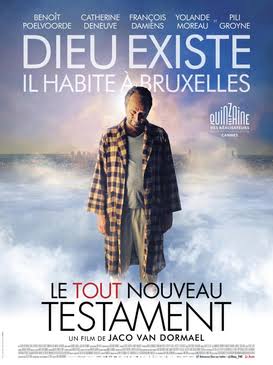
IMDb meta-data is a runtime of 1h and 54m rated 7.1 by 31,066 cinematizens.
DNA: Belgian.
Genre: Comedy; Species: Black, very.
Verdict: Big heart; bigger imagination.
Tagline: What a bastard!
Something to offend all the many self-righteous: blasphemy, cruelty, bestiality, profanity, pornography, prostitution, and more. The surprises just kept coming.
The reality is that God continues to lay down the law from a slovenly apartment in Brussels that he never leaves. Each new law is even more petty, spiteful, and meaner than the preceding 2,507 ones. He is a right bastard, dyspeptic, short-tempered, mangy, unwashed, odiferous, and selfish, a being who delights in the misfortunes of people. He embodies pride, greed, gluttony, wrath, sloth, the whole seven and more all rolled into one.
He is, indeed, old school, Old Testament in worn carpet slippers and a torn bathrobe with a grey singlet that might have been white, once, long ago in B.C.
His son, JC, rebelled against the old bastard, and that provoked God to even more meanness, starting with abandoning his only son. It has been downhill since, as he lays down one law after another, e.g., a dropped piece of toast always lands buttered side down! The other line always moves faster than yours with a corollary that if you can change lines, the new one stops. Remember Law 2003? The freeze in your computer does not occur when the technician logs in with Team Viewer. The last bus left just as you arrived at the stop. No problem is too small for this god to take the time to make it worse. After all, he has eternity to make everyone’s life miserable.
Turns out, Murphy was right, far more right than she realised. It has all been part of the masterplan.
Now JC’s little sister has had enough and…she sets out to recruit more apostles to write a brand new testament. This sprite begins by leaking divine data before going on a quest to recruit six new apostles to achieve a balance. Meanwhile, she is pursued by her angry old man, that is, god to you, but since he has never been out of the apartment in the world before, he is not very good at it, and he keeps running into the consequences of the very laws he has promulgated.
Charming, amusing, surprising, insightful – these are the words that come to mind. There are loose ends, e.g., what happened to the tears she collected? Why is eighteen the right number? What does baseball (in Belgium?) have to do with it, anyway?
I came across it on TV5Monde+ and the irreverent summary was interesting as was the presence of Catherine Deneuve who at age 74 has more screen presence than most at 24. Her last credit on the IMDB of 150 films is dated 2026 so at 80 she is still trouping 0n. Her first credit was 1957. Every time I see her I think of Repulsion (1965).
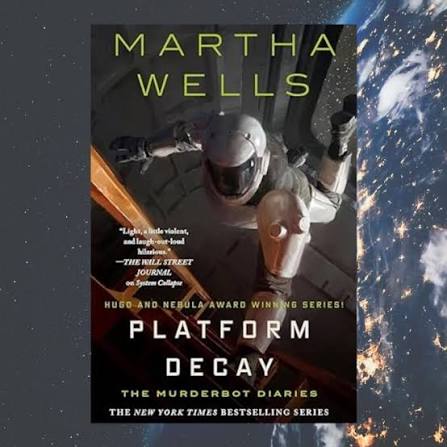
Good Reads meta-data is 256 pages rated 4.40 by 5029 litizens
DNA: USA.
Verdict: Decaying.
Tagline: SecU is back.
The return of the nameless A.I. Security Unit, part man, part machine, all diarist, as well as full-time couch potato media consumer is back, but his energy seems to be flagging.
The mission is to extract hostages with the subtlety Murderbot is known for. It seems almost too easy, and this is because it is. The ante is upped, and apple cart tipped. Much of the dialogue is SecU talking to himself, largely about the idiocy of humans, a subject without end, but also musing about his own growing emotional reactions which are not in any program module. This lets him to say ‘What the fuck a lot!’ Too much. More than 90 times by my count, thus about every third page. Any effect is blunted by repetition.
We are also in for preaching about sexuality and family. This is number #8 in the sequence, but the zip, zest, and zing are long gone, leaving only the sermons. The bastardy of corporations is rehearsed…again…and again. I got the message the first ten or so times.
AppleTV+ has a Murderbot series derived from these books, but I haven’t had either the heart or the stomach to see how many light years it is from the original. No doubt it will be aimed prepubescent boys with arrested development since they made it.