
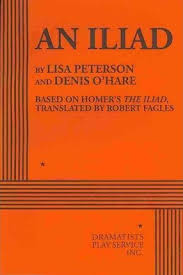
An Iliad by Liza (Lisa, sometimes) Peterson and Denis O’Hare at the Wharf Theatre (Available in book form of 96 pages (2014).
Medium: Live theatre.
Genre: Epic réchauffé.
DNA: Greek and Us.
Verdict: Exhausting to watch, and worth it.
Tagline: The war goes on, and on….
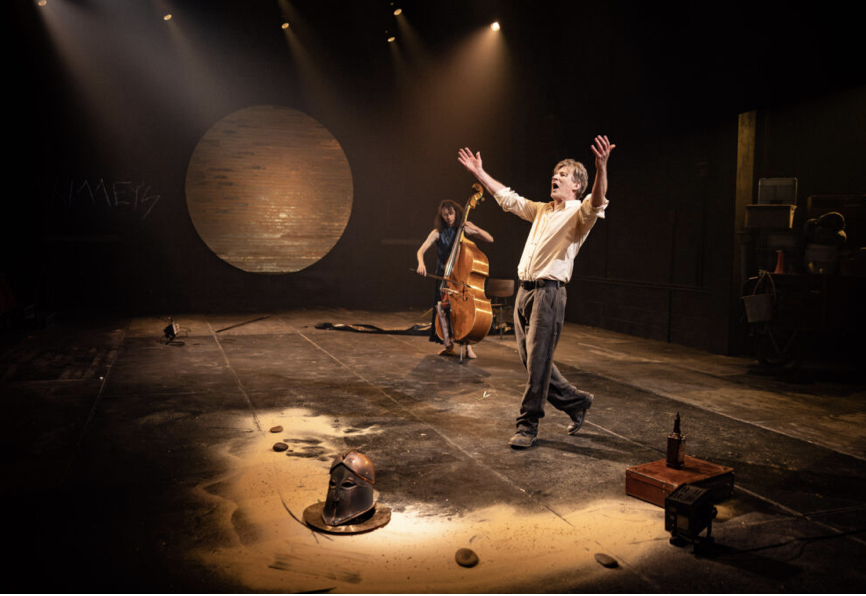
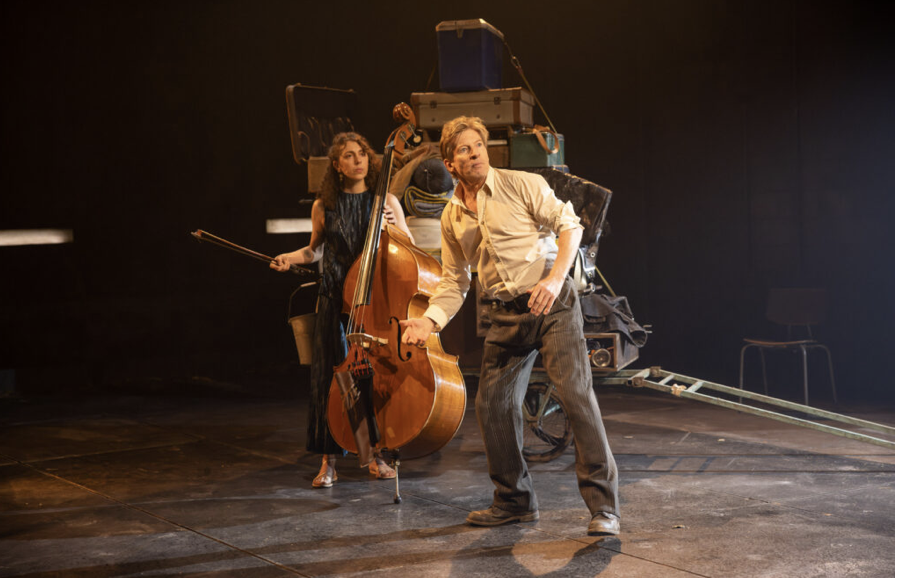
A one man monologue with Helen Svoboda’s double bass accompaniment. Those that claim to know say it would take more than twenty hours to recite all 15,000 drum-beat lines of dactylic hexameter. Ergo in a presentation just under two hours, most is omitted.
Aside from orientation, it concentrates on a few set pieces like the withdrawal of Achilles, the rejection of Agamemnon’s ransom, Patroclus misadventure, the death of Hector, and Priam’s supplication.
Greek though Homer was, the most sympathetic characters that he draws are the Asians: Hector, a man of responsibility, with his stoical wife Andromache and Priam, a loving father to his sons and to his people. In contrast the Greek Achilles never feels responsible to or for others and Agamemnon is more interested in himself than even his daughter Iphigenia. (If you know, you know. If not, find out.)
I particularly liked the inclusion of Achilles’ admission that he loves Briseis, which was omitted in the twelve lectures on the Iliad we watched on The Great Courses as homework for this show.
The historical and topical references were effective.
It is derived from the Robert Fagles translation, though I prefer Richard Lattimore in which Helen is treated as a plaything of fate, and not a villain. Indeed, in the Iliad there are no villains. That is the tragedy. See the P.S. below on translating the Odyssey.
Omitted from this script is one of the passages that seldom gets its due: the discussion between Sarpedon and Glaucus. They have come from far away as allies to the Trojans, and when the going gets tough they wonder why they are there at all. Their conclusion is a proto-social contract.
Our people have treated us like leaders with respect, deference, and material advantage, so we are obliged to act like leaders and uphold this alliance which benefits our people. Moreover, in so doing we show our worth to our compatriots. After all, what does it matter? We will die sometime, someplace, so it might as well be here and now to repay our obligations.
Glaucus replies, To the gods we are nothing more than falling leaves on the autumnal wind.
Quite so, yet when Sarpedon dies, Zeus weeps tears of blood on the sandy plain before Troy. Not even this god of gods can dam the river of mortality. Petrichor, the blood on stone scent of rain, the term was inspired by this passage: Petr = stone; ichor = blood.
***
David Wenham, 61, has come a long way from Diver Dan. This was a tour de force relying entirely on the actor, though there was a surprise when a hand first plucked the bass.
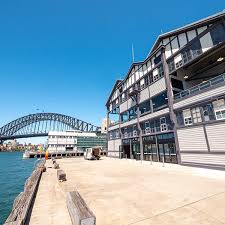
It was a Sydney Theatre Company production with brilliant, spare staging and direction that is the norm at the Wharf 1 Theatre which is on Wharf 4-5, and not on Pier 1 as we discovered by trudging around on a fine, sunny autumnal afternoon. Seats B1 and B2 suited us very well if and when we return.
We should lunch at the end restaurant some sunny day.
Inspired me to re-read something I published about Hector in a classics journal a few years ago, well, 1983. Perhaps I am older and wiser enough to rework this. Nope.
P.S. Thinking of those two translations remind me of the week long ago in an undergraduate class with Dr Sarah Jane Gardner when we pondered the fifth word of the Odyssey with which the man himself is introduced: πολύτροπον. Transliterated that is, polytropon. ‘Poly’ means many or much. ‘Tropos’ means turn, way, manner. Ergo it can be translated as ‘many-turning.’ And therein lies the rub.
Is Odysseus many-turning, or is he many-turned? Does he twrst and turn, or do the fates twist and turn him? Is he active or passive? A does or a victim? Is he cunning or is he vulnerable?
The translations on my shelf vary. Here is a selection.
Emily Wilson – ‘complicated’
Robert Fagles – ‘the man of twists and turns’
Robert Fitzgerald – ‘skilled in all ways of contending’
Richard Lattimore – ‘the man of many ways’
But the prize must go to Thomas Hobbes in 1647 who opted out of the problem said – ‘the man.’ Hobbes always cuts to the chase even more concisely than Wilson.
By the way, Odyssey is both turned and turning.
Of course, Odysseus is both a twister and a twistee.