
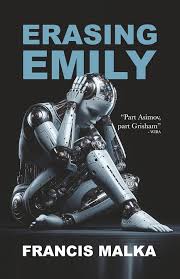
Francis Malka, Erasing Emily (2025)
Good Reads meta-data is 292 pages, rated 4.29 by 24 litizens.
Genre: Sy Fy.
DNA: AI
Verdict: It’s all in the title.
Tagline: She did it!
A parable about identity.
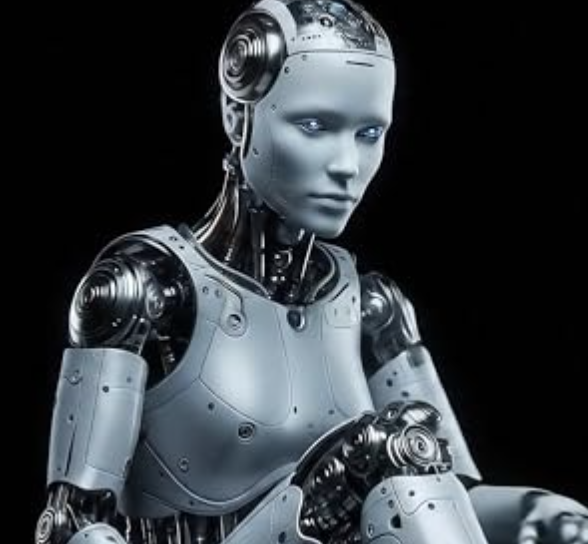
In a university library a man gropes a … robot, and it whacks him. This robot is the titular Emily. Oops! All of this is apparent from the security video of the incident. ‘Robot strikes man!’ screamed the ABC News bulletin, and not ‘Man molests robot.’
I know Frat boys are hard on and up most of the time but groping a metallic androgynous robot seems desperate even for one of them. How did he even know in the silence of the reading room it was a she, Emily? So what’s with groper? Near sighted as well as desperate? Does this make sense? Read on.
In this fictional world there are tens of millions of 1.0 robots that look and act like robots. Think Robbie’s descendants and you’ve got them. Now Apple has introduced 2.0 robots that still look like robots, but with integrated A.I. that allows for these model 2.0s to learn and develop. These 2.0 Robbie’s have been to school! One of those, as it turns out, is the aforementioned Emily.
Whatever!
It is a violation for a robot, however provoked, and what is so provocative about steel being touched anyway, to harm a human. Lawgiver Asimov made that the first precept. The penalty is to erase the robot’s memory, the personality, and reprogram the shell. Goodbye, Emily. To avoid this fate perpetrator Emily goes on the run. It seems AI has a selfish gene that wants to survive. (This app insisted on a capital after the period I put after the I in AI. The only way to get into lower case was to omit the period. Is this another example of the rule of A.I.)
Meanwhile, the McKinsey management of Apple is frantic to shift the blame for this malfunction on to… anyone else. Blame-shifting is a required minor in all accredited business degrees. But first the fugitive bot must be found. Both missions – shifting the blame and finding the runaway ‘bot — are landed on the design engineer of model 2.0. Though his expertise plays no role in what follows.
Engineer’s head is spinning with the unexpected, unwelcome, and upsetting news that a 2.0 has harmed a human being; he is nonplussed. Moreover, it is abundantly clear that if he cannot find the missing ‘bot, whom we know as Emily, and find out what permitted the Em to strike the man, Engineer will (1) be fired, (2) become a pariah, (3) and be arrested as complicit in the offence. And (4) he will be required to watch endless speeches from that idiot whose name shall never cross my keyboard.
Meanwhile, the free press beats the story to death with the sense of proportion and social responsibility we now expect: none. Pitchforks in hand, brandishing torches vigilantes turn on robots. Just for fun Pox News stokes the fire by calling them socialist robots! (Makes as much sense as anything else on Pox News.
If you were a runaway robot, where would you hide? Yep. Right. Where there a lot of other robots, because, well, they all look alike.
Now we take a sharp turn away from the mystery of finding the rogue to discover that all of this is only preliminary.
What follows is a court case to decide what a person is, and whether Emily has the rights of a person. Is she the Rosa Parks of metallic A.I.? A non-person who might be gavelled into being one by a judicial ruling? Discussing these points occupies more than half the book.
But wait!
Enter Perry Mason!
If Em goes to trial it would have to be a jury of peers. Yes? But she has no peers. She is no Shylock – neither tickled nor bled. There is nothing about this obvious point in the book but it came to my mind. Why isn’t the jury made up of robots? Good question, Mortimer. Collect the law degree on the way out.
Nor did I fathom why Engineer showed zero interest in Emily’s library assault. Indeed why was Em sitting in the library? One of the best ways to find out something is to ask. Why didn’t he? The voltes faces of first the lawyer and then the judge were too easy. However I did like the shelter for unwanted bots.
Here’s a new twist for me. I finished the book, and when I did a message arrived on the Kindle screen telling me there was an additional chapter if I wanted to read it. Big decision, right. I read it. How does that work in the printed book?
It resolves into a take on the Isaac Asimov story ‘Evidence’ (1954) for the cognoscenti that is a spoiler. In this context it undermines just about the whole book.
Not sure what to make of the idea of two endings. Seems the author should decide on one, not me.
Quibbling aside, it is an inventive book that kept me reading.