
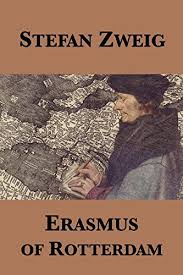
Good Reads meta-data is 124 pages, rated 4.03 by 1,806 litizens.
Genre: Biography.
DNA: Austrian.
Verdict: Brilliant!
Tagline: The Colossus of Europe
Desiderius Erasmus’s (1469-1536) home was Europe where he spoke no living European language, but only the universal Latin. He conquered Europe with his intellect, as Charlemagne had done with his sword and the Hanseatic League had with the abacus, from Rotterdam where he fell to earth, Louvain, Bruges, London, Paris, Mainz, Cambridge, Bologna, Cologne, Venice, Basel, and many points between all of these. Imagine the stamps in his passport. His broad mind and his pan European life made it appropriate to use his name for the Erasmus+ Program (European Community Action Scheme for the Mobility of University Students) (in a backronym) to facilitate education, training, youth and sport for students in thirty-three European nations.
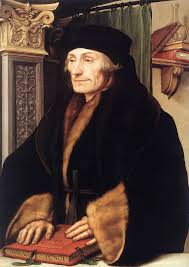
He was a public intellectual avant le mot. Besought at times by the kings of both England and France, the emperor of the Germans, the Pope of Romans, and countless princelings as an adornment to their menageries, he lived by grace and favour with greater grace and favour than he received. It is a measure of the fame of this praeceptor mundi that Hans Holbein did six portraits of him, Albrecht Dürer two; Quentin Matsys another. By contrast Niccolò Machiavelli, his contemporary, was never painted from life, nor ever by artists of such renown.
Erasmus led an army of books in battle on page after page with artillery of his pen captured one mental fort after another. He was the generalissimo of the Republic of Letters in his day and age.
About half of Zweig’s book is a comparison and contrast between Desiderius Erasmus and Martin Luther, the former a cosmopolitan, the latter a rustic; the former a sickly reed, the latter a thickset lumberjack, the former an alchemist with words, the latter a blacksmith; the former recoiled from tumult, the latter revelled the murder of his enemies; the former an apostle of free will, the latter a celebrant of determinism; the former wholly committed to being noncommittal, the latter fully committed to being fully committed. (My only previous encounter with the ghost of Martin Luther was reading Erik Erikson’s 1958 psychological biography of the man Young Man Luther in graduate school a few years ago. All I can recall from that is Luther’s gargantuan ego.)
I regret that while in Basel once upon a time I had neither the wit nor the wisdom to visit Erasmus House.
The book is not a chronological biography but rather a personality study of these two protagonists. In that it is magnificent, having whet my appetite for a chronological biography of Erasmus. By the way this exercise reminded me that in high school I read The Cloister and the Hearth (1861) by Charles Reade, though I now recall nothing of it but the title and its connection to Erasmus.
Zweig (1881-1942) wielded thunderbolt prose. His words rise off the page to meet the reader halfway most often through antinomies, apparent contradictions that engage that spark a reaction. At other times it seems he is whispering into the ear of the reader with a quiet urgency. His pages seem to live, breath, and quiver with life. He wrote biographies, history, and fiction. We saw his play Beware of Pity (1939) a few years ago performed by an Austrian company. It gripped me.
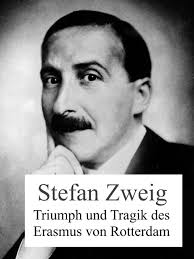
If Erasmus was at home wherever he had a writing desk, ink, and quill, Zweig was not. Austria topped Germany in its anti-semitism by the latter 1930s and with the coming of the Anschluss he immigrated to Brazil (via family connections) with his wife. There he made an effort to learn Portuguese and to fit in, but failed, and he felt like what he was, an unwilling exile in a strange land, vast not compact, moist and verdant, not glacial and snow capped, and so on, and in 1942 the two of them committed suicide.