
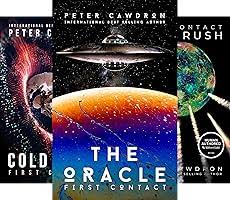
The purpose of this essay is to draw attention to a creative and prolific author resident of Queensland. It was thanks to Amazon’s Mechanical Turk that I became aware of him and his works, but I am glad I did. Here’s hoping some others might discover him by reading this brief.
Rather than comment separately on each of the titles in this remarkable series, it seemed best, and easiest for me, to present them as a whole accompanied by some general remarks to orient readers and remind me of what I have read. (Though I reserve the option of later reviewing an individual title or ten.) Impressive as the list is since 2011, for example, six full length novels appearing in 2025 alone, it is not the complete list of his publications. There are other genre novels apart from these. The total runs to at least forty (40)! It is best to read the list sitting down, least one grow faint. At this time there are thirty-three titles in the First Contact series, nearly all run to about 200 pages. Both this series and my reading are continuing.
The series is unified by its theme, namely First Contact between Earthlings and Aliens, a tried and true motif in science fiction since Murray Leinster’s eponymous story in 1945, though I suppose H G Wells’s War of the Worlds (1898) is an earlier example. Each story is self-contained and there are no continuing characters or other continuities. It is a one-man anthology on its theme. Consider a comparison to a version of The Twilight Zone or Black Mirror in which each episode concerns First Contact. Each episode is distinct but all are written by the same author, yet there is no overlap of character, milieu, or circumstances in any of stories. Whew! What a feat of imagination! I know I have said that twice but it needs to be emphasised.
There are period pieces, set in ancient Greece, Renaissance England, and 1950s American suburbia. (None, in my ken, is set on the Sunshine Coast near the author.) Others occur in low Earth orbit or the distant and largely theoretical Oort Cloud and beyond. Sometimes the initiative is human, and sometimes not. The contact is an invasion at times, initiated by aliens or by Earthlings. At other times the contact is one-sided, not mutual. Some contacts are inert, but most are dynamic.
In every case the level of verisimilitude is high. The most impressive aspect of that is the ease with which, and no doubt it was not easy, Cawdron animates an American Congressional intern in one book, and a high school girl working at a fast food outlet in the next, an aging archeologist in German occupied Greece, a motivated Soviet astronaut doing the Cold War, an Elon Musk clone raiding employee pension funds, an early Renaissance witch-hunter looking for another victim, a general of the People’s Liberation Army who follows the Tao of Sun Tzu, innumerable scientists and several flygirls, and more than a few innocent bystanders swept up by events. Each has a distinctive voice and persona even if the appearance is but a cameo.
The Aliens from his mental zoo also take a variety of forms. Some are unseen, others are ectoplasm, some are grotesqueries, others humanoid. Often they are silent observers. In other novels the Aliens are represented by technology. On the occasions when the Aliens communicate, they have a tendency to lecture about our faults, though they are not nearly as preachy as so many ostensible science fiction stories are these days. Often they do not communicate.
In each case Cawdron digs into the context with a mass of details that provide a rich context whether it is the technology of deep space exploration, surviving in the wild hinterlands of the Sudanese desert, or watching a take-no-prisoners Congressional hearings in D.C. He displays an impressive amount of research for each tale and integrates it smoothly into the stories. That said, it is also true, especially in the earlier titles one character explains to another all the details generated by that research. TMI.
On the other hand, there are many finely judged insights. Here is an example. It is a commonality in science fiction that we Earthlings want and would benefit from advanced alien technology. Would we? Could we? Imagine a Stone Age man getting an iPhone. It is advanced, alien technology to be sure, but what is this man to do with it. Throw it at prey? Ditto this same alien giving an Surface tablet to Cicero. What would he do with it? Sit on for warmth while the battery lasted?
A few of the book are homages . The most obvious are pastiches of Shakespeare’s The Tempest as mediated by the film The Forbidden Planet (1956) and its Krell. These are, you guessed it, The Tempest and Little Green Men. All in all it would seem Cawdron is a reader as well as a writer, and one well-steeped in the science fiction library.
The ones I read during our month on the Gold Coast are shown in blue below. I particularly liked the three shown in bold bluebelow, but overall I must have liked them all because, as with Oliver Twist, I wanted more. And there are more for the reading! My work is not yet done. The table below indicates the scale of Caldron’s project. The varied settings, as indicated above, show the scope.
| Title | Title |
| Anomaly (2011) | Cold Eye (2021) |
| Xenophobia (2013) | Generation of Vipers (2022) |
| Little Green Men (2013) | Clowns (2022) |
| Feedback (2014) | Tempest (2022) |
| My Sweet Satan (2014) | Apothecary (2023) |
| Galactic Exploration (2016) | The Art of War (2023) |
| Starship Mine (2016) | Ghosts (2023) |
| Welcome to the Occupied States of America (2016) | The Artifact (2023) |
| Nosferatu (2017) | The Anatomy of Courage (2024) |
| Maelstrom (2017) | The Simulacrum (2024) |
| Losing Mars (2018) | Love, Sex and the Alien Apocalypse (2024) |
| 3zekial (2019) | Entropy (2025) |
| But the Stars (2020) | The Minotaur (2025) |
| Wherever Seeds May Fall (2021) | Dark Beauty (2025) |
| Déjà Vu (2021) | Gold Rush (2025) |
| Jury Duty (2021) | The Darkness between the Stars (2025) |
P.S. Those that bored me, I skipped many pages.