
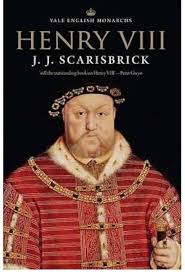
John J Scarisbrick, Henry VIII (1968).
Good Reads meta-data is 715 pages rated 3.85 by 218 litizens.
Genre: Biography.
DNA: English, very.
Verdict: Miles from the cartoon stereotype.
Tagline: ‘I am; I am.’ (For those with a long memory.)
Teenage Henry came to the throne unbidden, as it were, when his older brother died. The spare took command from the heir like George VI when bro Eddie stood down. High policy of a Spanish entente led to matrimonial politics as it often did in this period, and at 19 he married his brother’s widow, Catherine of Aragon who was 24. They set about their first duty to the realm to produce an heir and a spare themselves. Many were sired but unborn. Stillbirths, miscarriages, and death I lost count 6 in all. Worse! A girl named Mary.
Through all of this and that which followed as she was displaced, Catherine was pious, resolute, dignified, perspicacious, and stable unlike her mercurial husband and then ex-husband. Hank could have done well to learn from her but he was too immature to do so, and it seems from this telling, because he was the spare, little of his upbringing prepared him for the crown.
The popular stereotype of a bloated degenerate chasing women is far from the mark, though toward the end of his life he did begin to live down to it. The quest for a wife was not just libido, after all kings have had mistresses since, well, since there were kings, but had much more to do with the succession. He needed his own heir and spare, first to secure his own tenure, and, secondly, to keep the realm stable. If foreign rivals, if domestic aspirants thought there might be an interregnum, they would act accordingly. Plague, fever, accidents had killed many a king at an early age, and might do so again. Wait and see, temporise is often the best policy.
Without an heir, many a magnate might aspire to the throne and manoeuvre, rebel, or resist to get it when Henry died, and might even be tempted not to wait for his natural death. Equally, without an heir, and with domestic instability, foreign potentates might prefer to wait him out.
Matrimonial politics was a linchpin of the age, and it is complicated. If he took an English wife from a noble family, that family would be positioned near the throne and might use that leverage to plot against him. Moreover, that favouritism showered on one noble family would alienate every other great family and set them to plotting. To prefer one is to alienate all others. Making one friend makes many enemies.
Ergo, there is something to be said for a foreign wife. Ah, but that too had perils. To take a German wife related to the Holy Roman Emperor might please that vacillating incumbent in his long-running contest with the Pope, but… there is France to consider, and Spain, and the Pope himself. And so on and so on and so on. To make a matrimonial alliance with one power was to alienate the others.
Foreign war he found much harder than jousting and soon gave it up, turning to conniving where – after the passing of Wolsey – he was regularly out connived by one pope after another, one French king after another, one Spanish king after another, and one Holy Roman Emperor after another. Wolsey in foreign policy and Cromwell on domestic matters, if left alone, were successful but their successes bred Henry’s suspicion and distrust for he seems to have been a deeply insecure man – if we venture onto psycho-biography – beneath the bluff mask.
[ See on You Tube ‘Re-creating KING HENRY VIII with the help of AI.’ ]
This biography ends with a summation chapter that weighs Henry’s credit and debits. However, this spreadsheet does not include the death toll of his regime, so I have added a comment on that below.
Credit – He laid foundation of England, Great Britain, and eventually the United Kingdom to become a nation(s)-state following the example of Spain and France; established a professional bureaucracy; began building a navy with warships and not just transports; removed the foreign influence of Rome, established the national church and all that went with it; did much to codify the laws of the lands…and more.
Debit – He inherited a prosperous and stable realm which he drove into and out of debt with his reckless gambits, and adolescent indulgences that lasted his entire life. He destroyed his two most able and loyal ministers in Wolsey and Cromwell, and paid the price thereafter, or his realm paid for him. The foreign policy achievements of his tenure were largely of Wolsey’s making, while the domestic achievements came from Thomas Cromwell’s hand.
No sooner had he become king than he embarked on the first of three unsuccessful foreign wars to reclaim the French lands that by convoluted logic were English (thanks to William the Conqueror). He squandered a great deal of dosh and good will — both domestic and foreign — in these adventures. The tales of negotiations with Spain, France, Pope, and Holy Roman Emperor put Machiavelli to shame with the duplicity, connivance, deceit, and downright lies. In most of these negotiations Henry paid, and paid, and paid to subsidise his temporary allies, especially when Wolsey was not there to restrain the royal cheque-writing hand.
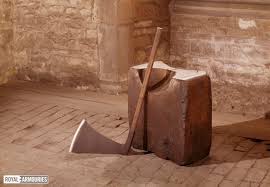
Then there is in his policy the rule of the axe in the domestic realm which slayed many. Estimates of the death toll exacted in his regime very greatly from 72,000 to 20,000. Wikipedia has a spreadsheet. Take a look. The wholesale destruction of people to make a new regime, reminded this reader of Stalin making the new Soviet Man by eliminating those who did not fit in. Like Henry, Stalin fought off foreign enemies, disciplined a state bureaucracy, mobilised industry and recruited a huge army, built roads…often over the bodies of loyal subjects.
This book is closely argued and clearly written, larded with insights, and a boon in untangling reality for the reader. It does not rely on cardboard stereotypes so beloved in the popular culture’s renditions of Henry, who, it has to be said, invited these depredations.
The used volume I acquired is errant in that page 528 is succeeded by…page 625. For second I thought I had read a lot more than I had in that afternoon, but then later page 672 is followed by page 577. Whew! That means about 50 pages are missing between 528-577. I have accepted that gap as Seshat’s will and leave it at that. Amen. (If you don’t know, look her up, yes Seshat is female. She is more reliable that the flighty Hermes who is created with creating the alphabet.) My interest in the intricacies of Tudor theology and politics was sated and I chose not to pursue the missing fifty pages.
The only other time I came across such a gap in a book was another Penguin edition, which this one is too, of the Forsyte Saga that I bought in Amsterdam. When I discovered the gap I took it back to the bookstore and swapped it for another with a clerk who was very responsive. In this case, I did want to know what was in the missing pages. N.B. If the missing pages had been the last chapter, well, I would have wanted to fill that gap. It is more likely a narrative of theological hairsplitting.