
Hypotheticals are often very entertaining, and sometimes, though rarely, informative.
Woodrow Wilson concluded in October 1916 that he would lose his bid for re-election in November against Charles Evans Hughes, the Republican nominee. As a constitutional specialist Wilson had always deplored the hiatus between the early November election and the inauguration of the new president in March of the following year. During that three month period — the lame duck period — the incumbent had no legitimate authority though the formal powers remain.
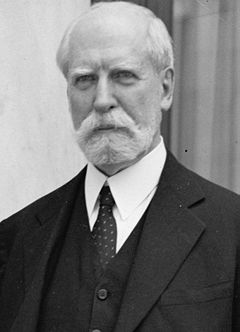
Charles Evans Hughes
In 1916 the lame duck would be no laughing matter with submarine warfare a weekly occurrence off the Atlantic coast of the United States and Europe burning in an endless war on a gigantic scale while Japan sharpened swords in the Far East and eyed Mexico. In that situation Wilson had no wish to exercise the formal powers shorn of a popular mandate. Moreover, he thought the people’s choice should take on the responsibility immediately.
He made a secret plan to accomplish that end while staying within the Constitution. Here is how he proposed to do it. As soon as it was official that Hughes had won, he would dismiss the Secretary of State, Robert Lansing. Wilson would then appoint Hughes to be Secretary of State. While Congress is not sitting the President can make acting cabinet appointments like this as a temporary expedient until Congress reconvenes. Once Hughes accepted the appointment, Wilson would ask his obliging and unambitious Vice-President Thomas Marshall to resign. Without a doubt Marshall would have readily complied. (Lansing would have almost certainly resisted but he served at Wilson’s pleasure and at the end of the day would have had no choice but to stand aside, willing or unwilling.)
With the way then clear, Wilson would himself resign, and by the existing line of presidential succession the baton would pass, absent a Vice-President, to the Secretary of State, Charles Evans Hughes who would also be President-Elect. Wilson’s supposed that this could be done within three days or even less once the election results were known. Hughes had only to travel from New York to Washington and say ‘Yes.’ Of course, Wilson hoped against hope to win, so he put the plan which he had typed himself in a desk drawer and waited.
On election day the result was close, and in 1916 reporting results was slow and sometimes uncertain since journalists sometimes jumped the gun. (No comment.)
It seemed by late evening on the East coast that Hughes had won. Hughes went to bed believing he had been elected President of the United States. But he woke up to find that California had voted for Wilson and the left coast was enough to keep Wilson in office. The secret plan went into the locked filing cabinet of history. Would a president today think so hard about the best interests of the country and be prepared to concede to an opponent to serve that interest?
In 1933 the XXth Amendment to the United States Constitution reduced the gap between the election and inauguration from early November to January and re-routed the Presidential succession, after the Vice-President, through the presiding officers of the House of Representatives and the Senate before going to the Secretary of State.
There are two competing principals. The first is that a successor should be someone aligned with the president and au fait with current developments in the executive, hence the Secretary of State as the most important cabinet office should be third in line. That principal applied until 1933, despite Secretary of State Alexander Haig’s remark when President Reagan was shot in 1981.
The second principal is that the successor should be an elected official with broad responsibilities, hence the presiding officers of the legislatures. While not members of the executive, they are engaged with the daily processes of government.
Eight of 44 presidents have died in office. In each case the successor was the VIce-President.
By the way, Hughes had a long and varied career in public service: Governor of New York, Associate Justice of the US Supreme Court, Secretary of State, Justice on the International Court of Justice, and Chief Justice of the US Supreme Court.
Category: Review
Agatha Christie, A Murder is Announced.
We went to see ‘A Murder is Announced’: A Miss Marple Mystery’ at the Sydney Theatre at Walsh Bay last night. Most enjoyable. Kate did everything after I very obliquely hinted that this play would be a fine birthday present for moi! **** Four Stars from me!
The set and cast evoked a bygone time from the 1950s. I was impressed with the way the actors looked like all those other actors in BBC dramas. The RAF mo’s, the flounced dresses, the side saddle sitting, the inspector inevitably in an raincoat… This play was so much fun, in part, because everyone in the audience knew the story, and I am sure everyone in the production assumed that. In that way it is like Swan Lake or the Iliad. There will be no surprises. Well, no big surprises, but quite a few little ones. Mitzi just about stole the show! Jane’s dead pan reply to the Inspector when rhetorically asked “Do you want my job?’ Of course, the main elements are deceits, layer after layer.

Perhaps the most curious thing in the staging was the cigarette smoking. It is in the text and was honoured here, but, as far as I could tell, only one of the actors with a cigarette puffed it like Bill Clinton. Most of the other cigarettes, after the ritual of lighting, were neither lit nor smoked. A production decision, it seems, delegated to the actors.
I have come back to Christie through the Poirot and Marple films. So meticulous, so analytic, so dogged and yet with a certain gentility of the time and place that is now relief from the too loud, too noisy, too garish, too simple, too fast, too dumb, too abrasive varieties of television policiers, most of which have the subtlety of a finger in a power point! I once read a lot of Agatha Christie but went off her in favor of the Mean Streets Noir books from Raymond Chandler, Ross MacDonald, Margaret Millar, Patricia Highsmith, and so on. The mature conclusion is both styles have a place in the pantheon.
By the way, Christie fans might like to know that she is a character in Max Collins’s The London Blitz Murders (2004).
Sydney Moderns
We found the time in our busy schedules of good works to go to the Art Gallery of New South Wales to see ‘Sydney Moderns: Art for the New World.’ The items ranged from 1909 to 1947, spanning both the World Wars.
It was well worth the visit to see the works gathered and to follow the narrative in which they were placed. In this case ‘modern’ seems at the outset primarily to have meant the dominance of colour over content. Several of the themes in the exhibition explored colour. Regrettably the pastels made me think of the 1980s.
The reference point for the moderns was the Sydney Harbour Bridge, because it dwarfed all else in the city (and the country) and represented, in their minds at least, the triumph of modern engineering over the natural barrier of the harbour.
But as we traveled through the exhibit ‘the modern’ took on other meanings, specific examples include the inclusion of machinery in art with painting of factories, train stations, automobiles. It also meant modern life which became in the period covered decidedly urban. Urban life meant apartment buildings higher than before, it meant crowds on the street, and it meant – those beloved temples of commerce – department stores capitalizing on the critical mass of consumers in cities. More generally, the modern also meant breaking with the artistic conventions of the past and so included Margaret Preston’s still-lifes and her experiments with Aboriginal motifs.
It was refreshing to see that the loose groups of Sydney modernists also embraced commerce and strove for decorative features in their works to sell to users, not just collectors, but users. In this respect the role of the magazine HOME was emphasized, and its pages were also open to photographs as a modern art form as well as the design of furniture.

We saw an exhibition last year or earlier of German art between the wars, Weimar, and it most of its works were dark, brooding, sharp-edged, and out of control. They portrayed a world teetering on the brink of a black abyss, even in the style of coffee cups! Quite a contrast. Sydney Moderns is on the whole optimistic and happy with the world.
While comparing it to the other efforts, a lot of this was going on when Castlecrag was developed but I saw no sign of interaction with it.
The narrative in this very well curated exhibition also makes clear the community of artists who cooperated, competed, and learned from each other. And those that sold decorative works seemed to have made a good living from it. Not the singular, starving artist of the garrett much loved in melodramas.